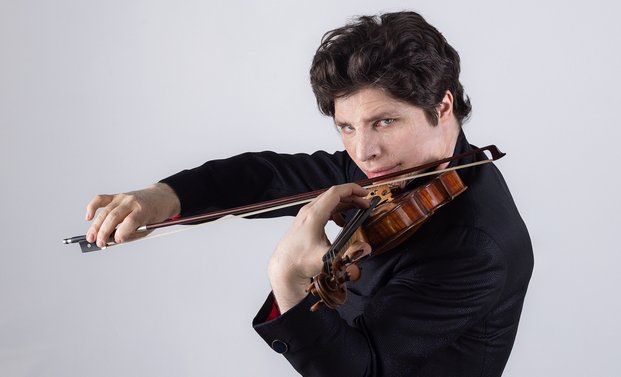
Performers
Programme
Accompanying programme
Concert introduction
Two composers, both threatened by the Soviet regime: Prokofiev wrote a violin concerto that could accompany a film of mystical, dark images, and Shostakovich wrote a symphony that itself originated in a dark period. It tells a highly impressive story of war and its horrors.
Shostakovich's Symphony No. 7, the „Leningrad“ is one of the monumental artistic testimonies of the 20th century: a work between hope and despair, written in 1941 in the shadow of the German Wehrmacht's merciless siege of the city, which claimed over a million victims. The music: a resounding record of threat and resistance, of propaganda and inner freedom, but also a scathing reckoning with totalitarianism that is as relevant today as it was then. Shostakovich, who experienced the blockade of Leningrad himself, names reality – Prokofiev, on the other hand, is a „storyteller“ in his Second Violin Concerto, at least as Augustin Hadelich imagines him. „Many of his works are very descriptive,“ he says. „You immediately begin to imagine scenes from fairy tales and stories unfolding.“ The violinist finds this narrative quality particularly pronounced in this atmospherically intense G minor concerto: „It begins very mysteriously with the violin alone (...), and when the orchestra joins in, the scene takes on a mysterious magic.“ (hr-Sinfonieorchester)