Performers
Programme
Accompanying programme
Concert introduction ‘before the museum’ with Ulrike Kienzle
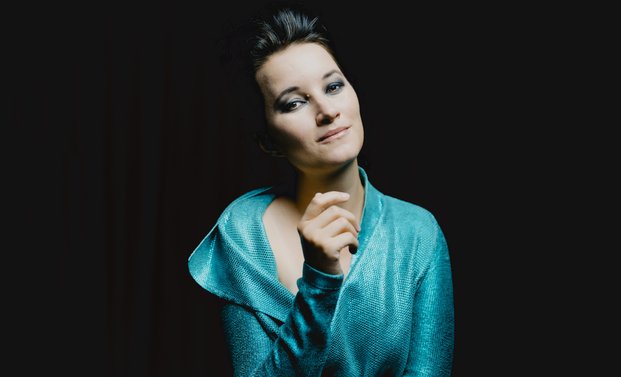
The notes of Hildegard von Bingen’s antiphon float down upon us like something mystical, descending ‘from on high’, when sung a cappella by Anna Prohaska. They offer a glimpse of the sounds of the Middle Ages. Even today, the remarkable Hildegard von Bingen continues to inspire and enrich us with her music, writings and recipes.
The music of Johann Sebastian Bach still seems otherworldly to us today. Although the 'Musical Offering' was merely a gift to Frederick the Great, we encounter something religious and mystical in this contrapuntal collection. Anton Webern orchestrated the Ricercar a 6 from the 'Musical Offering', breaking it down into individual motivic elements so entirely unfamiliar timbres emerge and new structures become audible.
The opera and concert arias of Wolfgang Amadeus Mozart are almost supernaturally beautiful yet deeply human. He usually wrote them for specific singers, particularly female singers who were attractive on stage and had a versatile voice. One such singer whom Mozart greatly admired was the prima donna Anna Storace. Before she left Vienna, he bid her farewell with a concert aria, for which he wrote an additional piano part. Hermann Scherchen, who conducted the Museum Orchestra in the 1920s, transposed the piano accompaniment to Franz Schubert’s song “Auf dem Strom” for orchestra.
Traces of medieval religious mysticism, Bach's counterpoint and Schubert's harmony can be found in the work of the great symphonist Anton Bruckner. His Fourth Symphony, also known as the “Romantic” Symphony, is particularly popular. In a letter, Bruckner wrote that the first movement is the “romantic image” of a “medieval town”, and that at the beginning, the horn “heralds the day from the town hall”. In the scherzo, Bruckner spoke of a ‘hunting theme’, and he titled the finale ‘Folk Festival’. Thus, this symphony depicts not so much nature, but rather a romantic picture of life in the Middle Ages, very much in the spirit of its time.
(Frankfurter Museums-Gesellschaft e.V.)