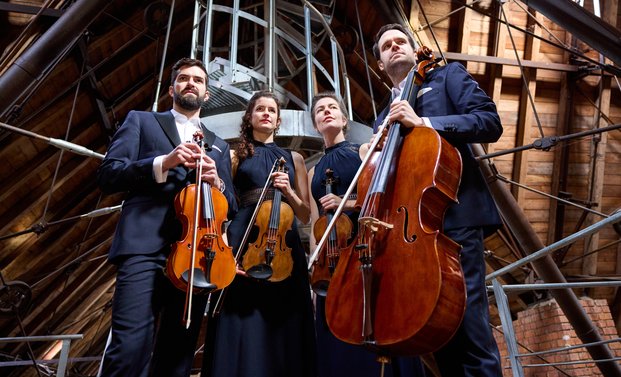
Performers
Programme
Streichquartett F-Dur op. 135
Streichquartett e-Moll op. 59 Nr. 2 "2. Rasumowsky-Quartett"
Ludwig van Beethoven’s compositional output is generally divided into three phases. The first phase is characterised by the influence of Haydn and Mozart on Beethoven’s early works. The second phase, or 'middle Beethoven', sees Beethoven expand the classical canon of forms structurally and harmonically, taking it into new dimensions. The third phase, or 'late Beethoven', sees Beethoven completely break with traditional forms and venture into entirely new sonic worlds. These new sonic worlds overwhelmed Beethoven’s contemporaries and continue to place the highest demands on listeners to this day. In each concert of its Beethoven cycle, the Aris Quartet juxtaposes a late string quartet with an early one and a middle one.
The second concert in the series features three quartets, each bearing a motto or nickname: Op. 18 No. 6, with its melancholic introduction to the final movement, is titled 'La Malinconia'; Op. 59 No. 2, the second of the three 'Razumovsky Quartets', is dedicated to the Russian ambassador of the same name at the Viennese court and honours him with a 'Thème Russe' in the middle section of the scherzo; and the final quartet, which features a final movement arising from the contrast between two conflicting motto themes in the form of a question and answer. “Must it be?” – “It must be!”
(Frankfurter Museums-Gesellschaft e.V.)